
How HyperGOLD works
HyperGOLD identifies free gold particles in pre-concentrated, size-classified samples and reliably distinguishes them from challenging background materials. It is built for practical deployment in exploration and production environments, and moves teams beyond visual inspection with particle counts, size data, morphology information, and estimated grade outputs that support confident technical decisions.
~15 seconds
Analysis time
300+ tests/day
Throughput
What each test reports
Each test provides quantitative and visual insight that can help teams understand where gold is present, how it appears, and how results compare across samples or locations.
- Gold particle count reported in seconds
- Particle size distribution to identify dominant grain-size ranges
- Reliable detection of gold particles as small as 50 microns
- Shape and morphology insights to compare samples from different areas
- Estimated gold grade to support vectoring and target prioritization
- Gold identification in challenging background matrices, including pyrite, chalcopyrite, and mica
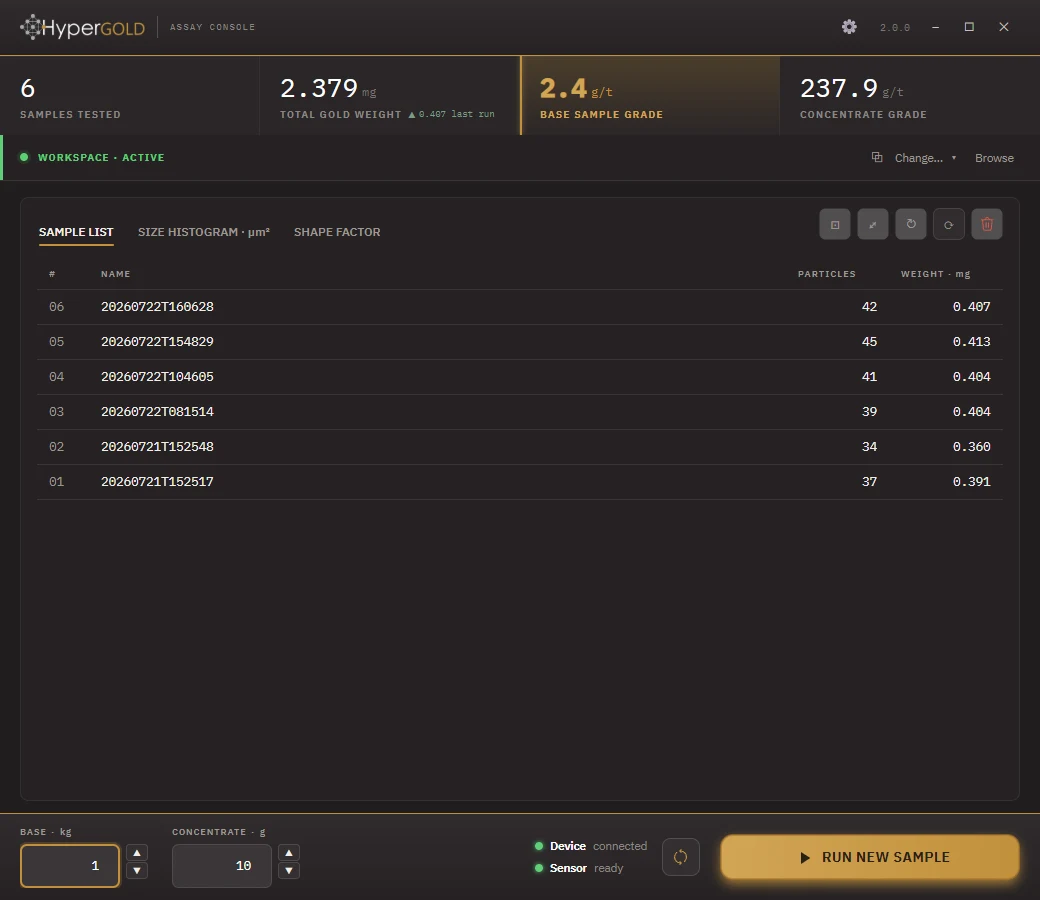
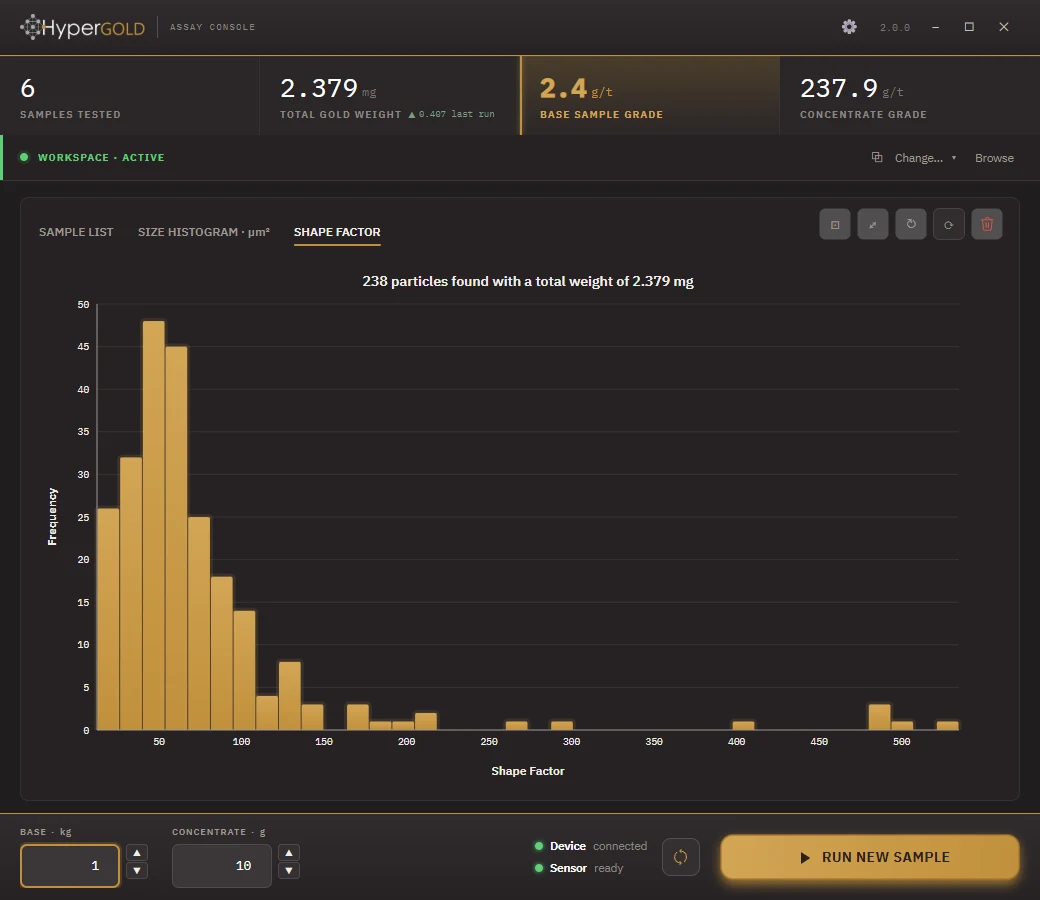
Screenshots show one recorded batch of six samples. Every figure in them is that batch's reading, not a typical or representative result.
Built for the field
Compact, mobile, and practical
The system is built for practical deployment in exploration and production environments. The device measures 250 × 190 × 140 mm, weighs approximately 2 kg, and is transported in a protective carrying case. It is operated and powered by a standard laptop.
Sample handling and safety
Sample containers hold approximately 3–5 g of material per test. Prepared material is distributed into containers using a sticky surface that retains a single layer for analysis, supporting consistent and repeatable testing across a batch.
Analysis is non-destructive — samples remain unaltered and can be stored, archived, or sent for further testing afterwards. The method uses no hazardous acids and avoids the ionizing radiation risks associated with some comparable detection techniques.
250 × 190 × 140 mm
Dimensions
~2 kg
Weight
Laptop powered
Power
Full device specification
The complete sheet, including the analysis time and throughput figures above.
Performance
- Analysis time
- ~15 seconds
- Throughput
- 300+ tests/day
- Detection limit
- 50 microns
Physical
- Dimensions
- 250 × 190 × 140 mm
- Weight
- ~2 kg
- Power
- Laptop powered
Sample
- Sample size
- 3–5 g
- Sample handling
- Non-destructive
Output
- Reported measures
- Count, size distribution, morphology, grade
- Matrices tested
- Pyrite, chalcopyrite, mica
Specifications are preliminary and subject to change. Nothing on this page constitutes a warranty or an offer to sell.
See HyperGOLD on your samples
Request a demo to see HyperGOLD's rapid, non-destructive gold detection on your own material — tell us about your operation and we'll follow up.